Visa Donates Original 17th–18th Century Rare Books to the Vernadsky National Library of Ukraine
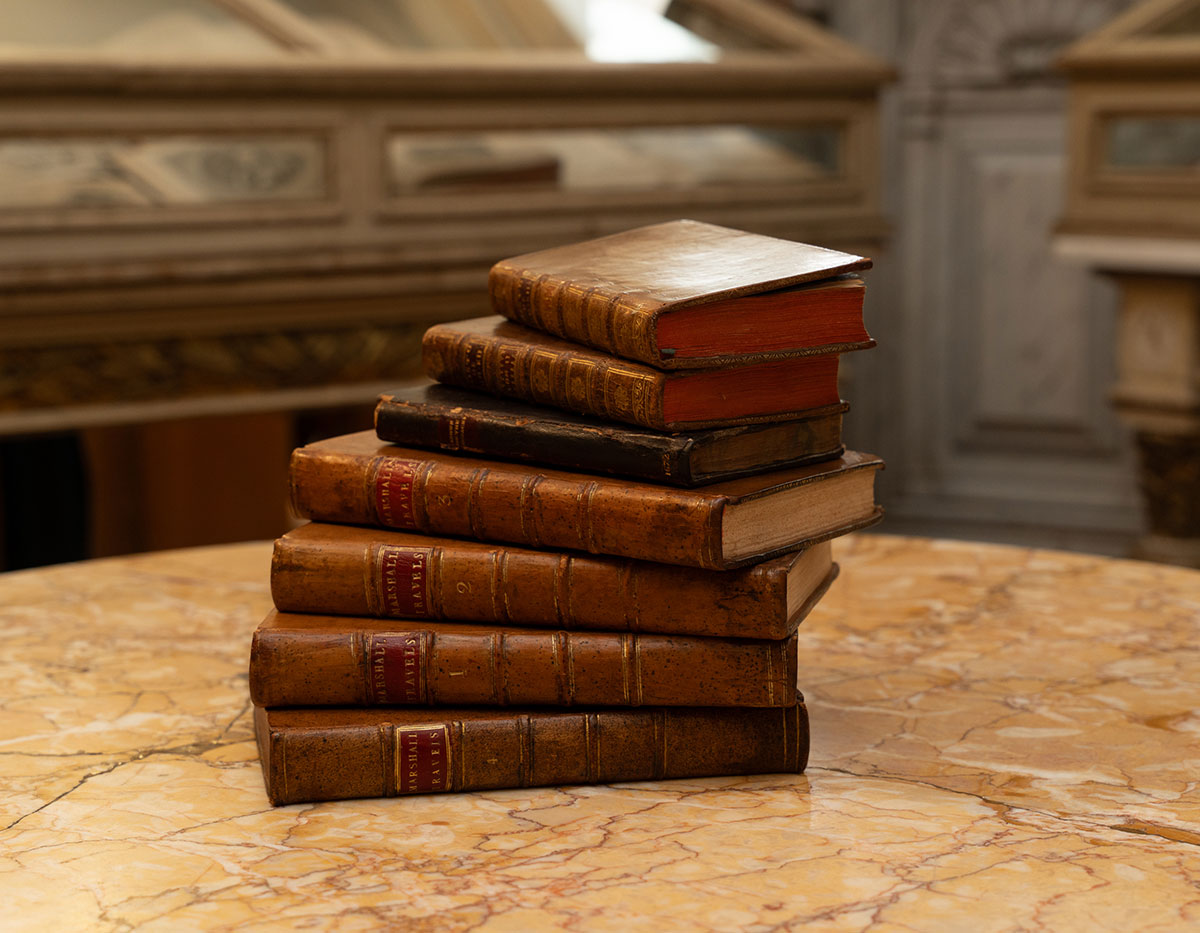
On June 3, Visa donated a collection of rare European books to the V.I. Vernadsky National Library of Ukraine. These works span the 17th and 18th centuries, reference Ukraine, and include texts by the traveler Joseph Marshall, philosopher Voltaire, and diplomat Pierre Chevalier. They were originally acquired for the interactive Ukraine WOW exhibition, where they were viewed by more than 250,000 visitors. The volumes have now become part of the permanent collection of the Vernadsky National Library of Ukraine.
These works are more than historical artifacts—just as they have survived the passage of centuries, they also preserve how Ukraine was perceived and described internationally, long before the emergence of modern narratives. The books were located and acquired abroad from private collectors with the support of Visa.
“We believe that by investing in cultural initiatives, we help unlock a country’s potential. Donating the works of the traveler Joseph Marshall, philosopher Voltaire and diplomat Pierre Chevalier, sourced from European collectors, ensures their preservation for future generations. We are delighted that these editions have now joined the rare book collection of the Vernadsky National Library, where they will serve as valuable sources for research and study for anyone interested in history,” said Tetiana Chorna, Vice President and Country Manager of Visa in Ukraine.
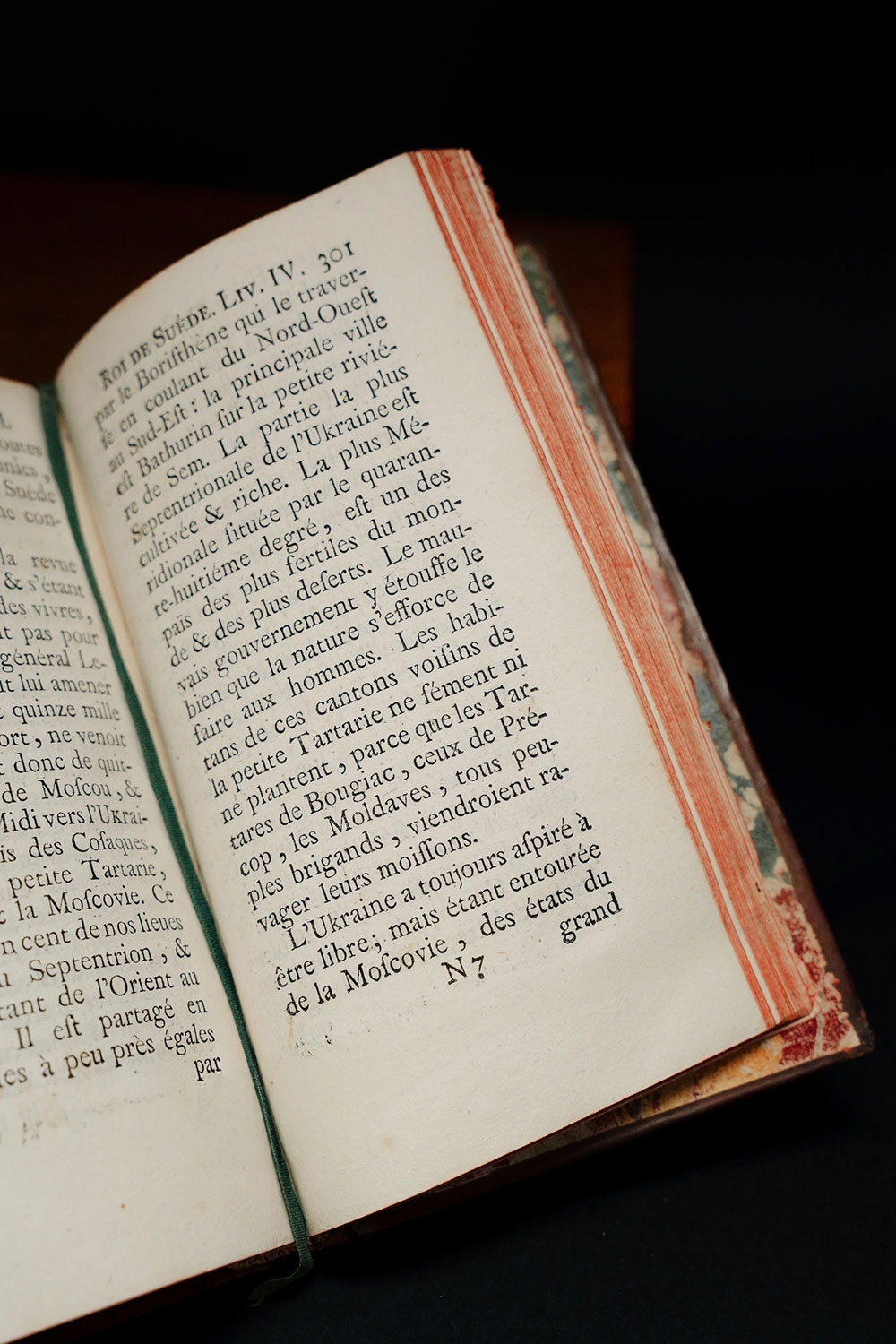
Among the donated works are both 1731 volumes of the Histoire de Charles XII roi de Suède (History of Charles XII, King of Sweden). In it, Voltaire describes events of the Great Northern War on Ukrainian territory, including Mazepa’s alliance with Charles XII and the Battle of Poltava. Ukraine occupies a central place in the narrative. Although Voltaire never visited Ukraine, he wrote about it with the rigor of a scholar and journalist, drawing on the works of Guillaume Le Vasseur de Beauplan, Limier, and Cantemir.
Through conversations with émigrés, most notably Hryhor Orlyk (son of Hetman Pylyp Orlyk), Baron Friedrich Ernst von Fabris and the Marquis de Maison, Voltaire learned about Mazepa’s plans and the Cossack struggle for independence. He also corresponded with contemporary eyewitnesses to the events, including individuals who personally knew Charles XII or had fought alongside him. One of his informants was Stanisław Leszczyński, King of Poland, who, like Mazepa, was an ally of Sweden during the Great Northern War.
This work played an important role in shaping Europe’s perception of Ukraine. Voltaire’s writings were widely read across the continent and testified to Ukraine’s presence on the political map of the world in the eighteenth century as a distinct country. Notably, in the book Voltaire did not use the term “Russia” (la Russie), referring instead exclusively to “Muscovy” (la Moscovie), thereby distinguishing it from Ukraine. This is particularly significant given that Tsar Peter I officially renamed his state from Muscovy to Russia only in 1721, in an effort to appropriate the legacy of the Kyivan Rus’. Voltaire, by contrast, provided Ukraine with a clear geographical and political identity, treating it as a distinct force in European history rather than conflating it with Muscovy. “Ukraine has always aspired to be free,” Voltaire wrote in the first volume of the edition.
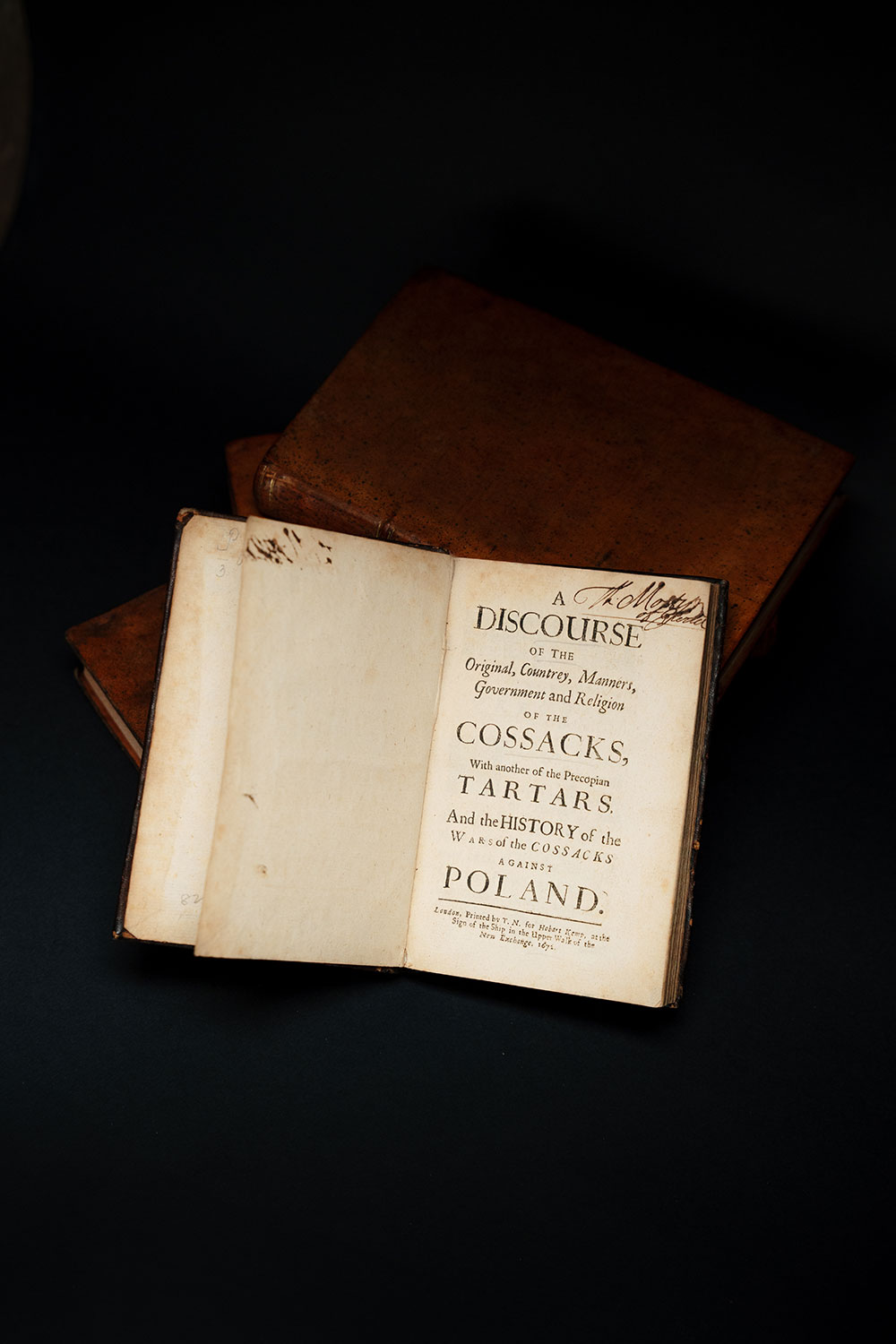
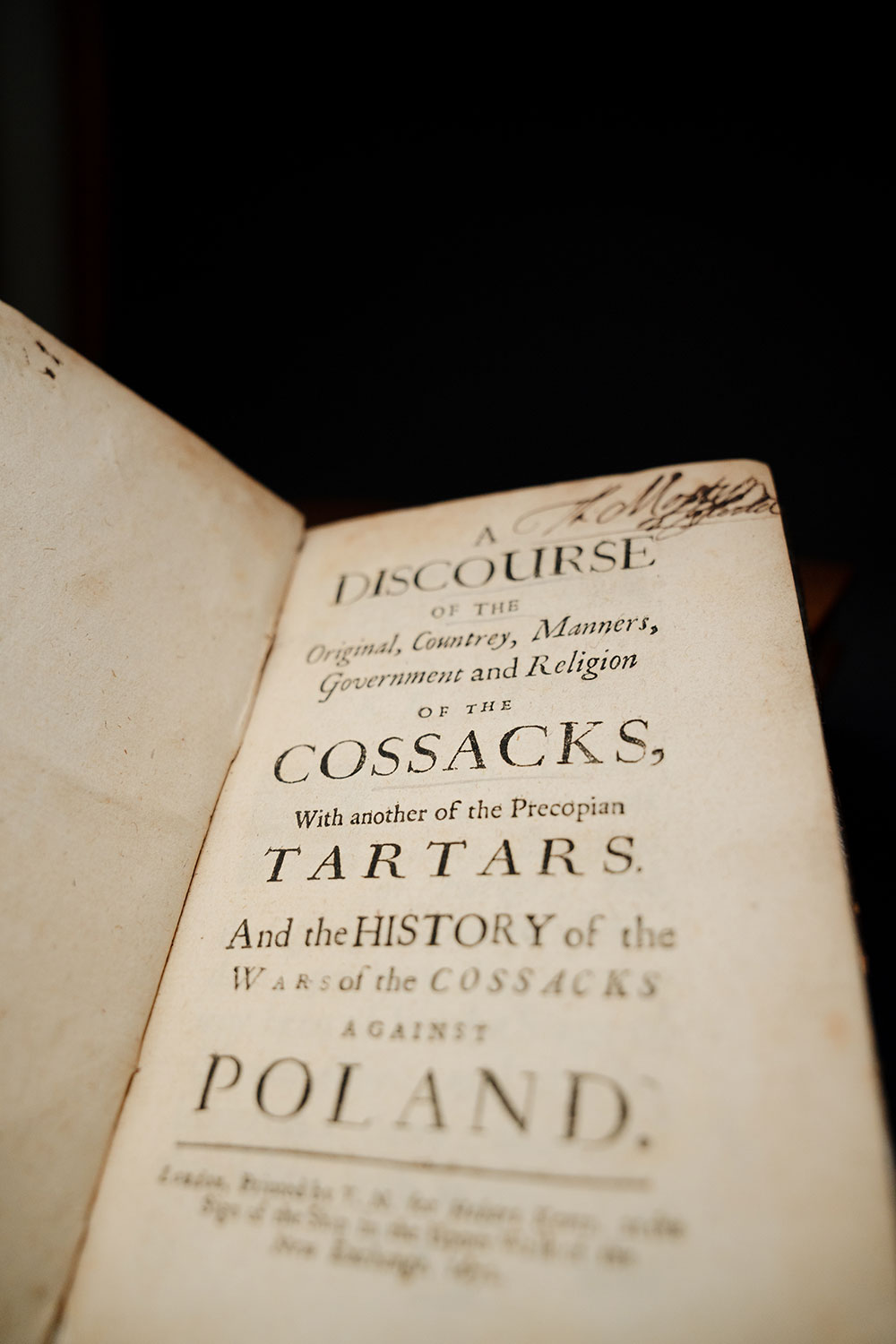
The library also received Pierre Chevalier’s A Discourse of the Original, Countrey, Manners, Government and Religion of the Cossacks, With another of the Precopian Tartars (1663), a unique firsthand account of Ukraine during the era of Bohdan Khmelnytsky. For centuries, it remained one of the principal sources for understanding Cossack statehood.
Pierre Chevalier, a French officer, diplomat and adviser to the royal mint, came to Ukrainian lands not as a scholar but as a military commander. Historical records indicate that he maintained contacts with Cossacks whom the French government considered recruiting into service. During the Khmelnytsky Uprising, Chevalier served as secretary of the French embassy in Warsaw. Over the course of a decade, he gathered unique observations on the customs, beliefs, governance, and struggles of the Cossacks. These experiences formed the basis of his History of the War of the Cossacks Against Poland (1663), which includes several sections, among them A Discourse of the Country, Customs, Government, Origin and Religion of the Cossacks. Importantly, Chevalier does not identify Ukrainians with Muscovites but presents them as a distinct people with their own land, language, and political aspirations.
The library’s collection has also been enriched by a 4-volume work by English traveler Joseph Marshall. Between 1768 and 1770, Marshall undertook a Grand Tour—a traditional educational journey through Europe for members of the British elite. Motivated by curiosity and a desire to see the world, he traveled to Ukraine and, upon his return, published Travels through Germany, Russia, the Ukraine and Poland (1772), which became an important European account of Ukrainian lands.
In 1770, his route took him through Starodub, Chernihiv, Kyiv, and Ochakiv. Marshall arrived without preconceived notions about these places and, perhaps because of that, saw more than those who viewed the region through an imperial lens. His journey was not merely a travelogue but a deep exploration of landscape and culture. “I found Ukraine to be an extraordinarily fertile and remarkably well-cultivated country, unlike the image I had formed from the books I had read,” he wrote.
Library visitors will be able to consult these works in the Reading Room of the Department of Rare Books and Early Printed Editions, as well as view them in display cases during guided tours of the department.
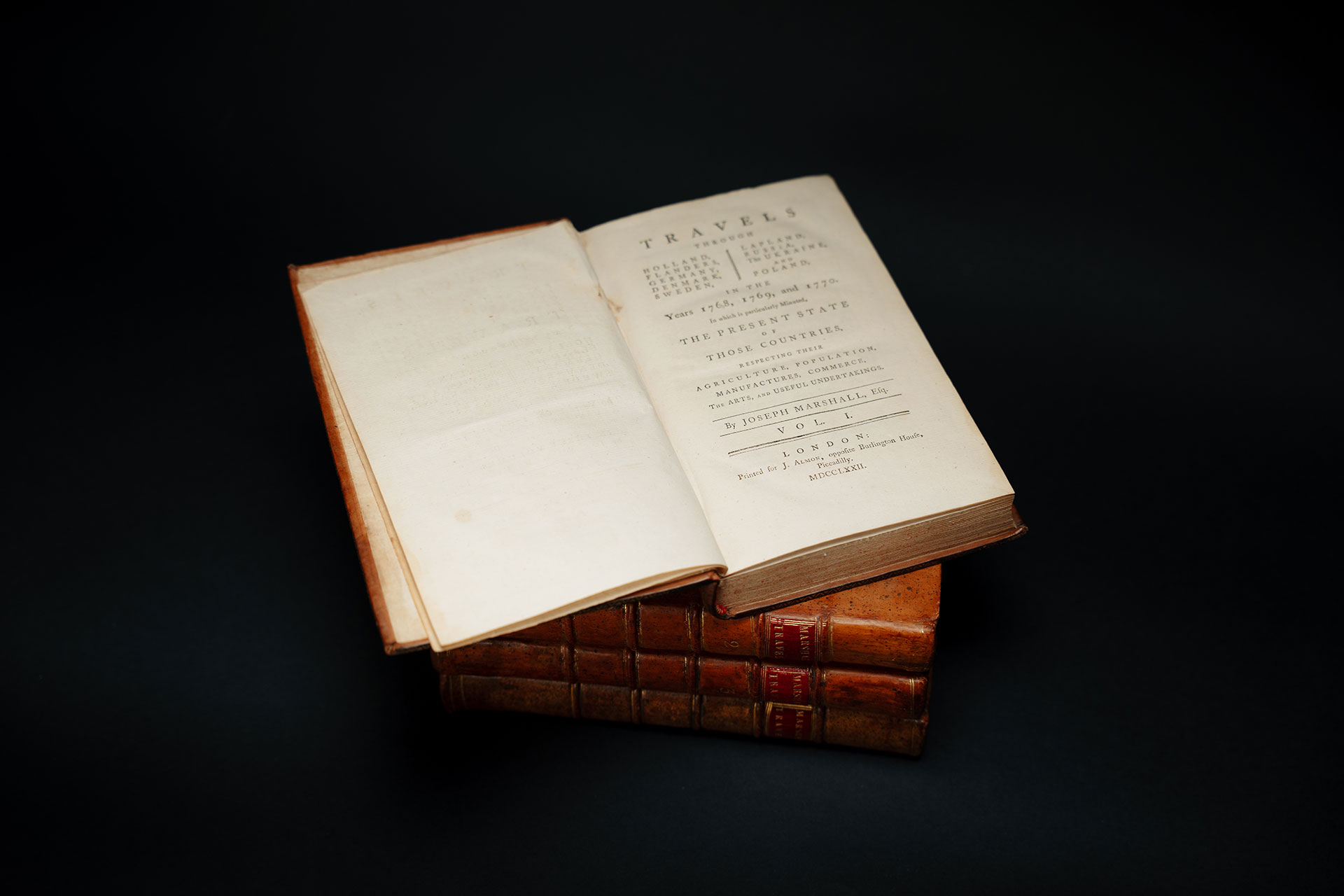
“For the library, this is more than an expansion of our holdings. It is an opportunity for everyone to gain a deeper understanding of our history and to explore how Ukraine was seen by Voltaire, Pierre Chevalier, and Joseph Marshall. Each of these editions helps us reassess long-standing perceptions of Ukraine that have developed over centuries. At the same time, they will soon enable readers from anywhere in the world to engage more closely with our history, as the books will be digitized and made available on the library’s website,” said Yurii Kovtaniuk, Deputy Director General for Research at the V.I. Vernadsky National Library of Ukraine.
Ukraine Wow